
our relationships are everything.
a few questions to consider:
- what is my relationship to this moment?
- what is my relationship to life?
- what is my relationship with others?
- what are the stories I tell myself about my relationships?
- what is my relationship to myself — my thoughts and feelings?
one of the things i learned in my assessments project on studying relationship satisfaction is that satisfaction so incredibly subjective. it’s a cognitive aspect co-created by those in relationships, and depends on contextual and interpersonal factors[i].

what does this mean?
well, after all the research, i stumbled upon a study conducted by Joel and others in 2020 where they utilized Random Forests – a machine-learning method or AI, so essentially a decision tree on steroids. after studying a number of constructs in an almost-infinite amount of combinations, they found that relationship satisfaction is based on one’s perception of the other’s perception of the relationship[ii].
let me simplify that.
let’s take our relationship, for example.
my relationship satisfaction is based on my perception of your perception of our relationship – so my subjective experiencing of your subjective experiencing of me.
yea. complex.
so i’d like to invite you to look at your world and interactions through relationships.
everything is in relationship, and our relationships are where we explore ourselves – our experiences, our existence, and our identities. our relationship to words, objects – our preferences. being human. experiencing. living.
and as human beings, we are “hardwired” to connect[iii], and we constantly are defining how we see ourselves, how we see each other, and composing, orchestrating, affirming, adjusting our worldviews[iv].
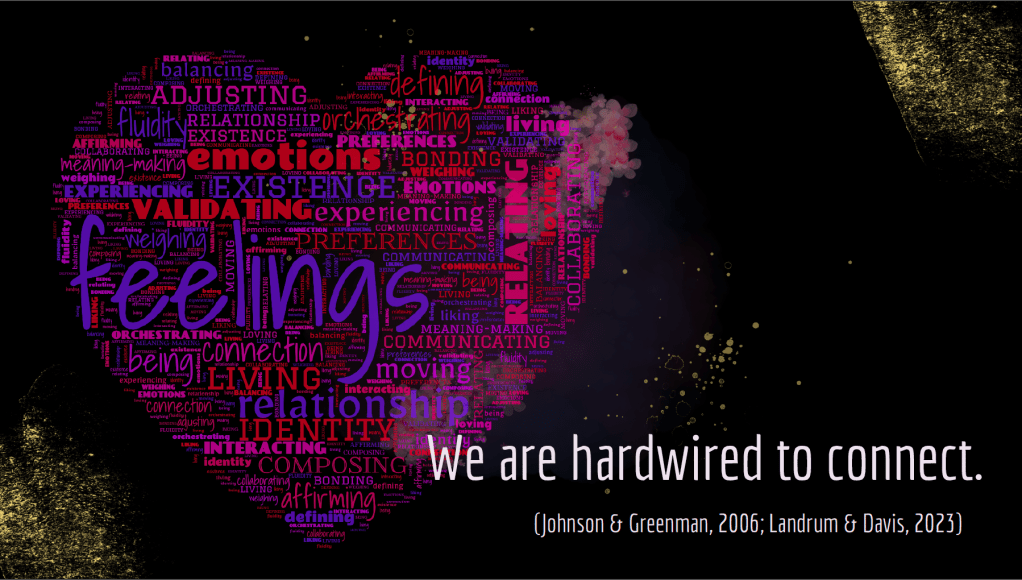
i like to think of each living being as kind of like a gyroscope, constantly weighing, adjusting, balancing all of these relationships. our capacity to make meaning, to connect and form bonds, and to create revolve around relationship, connection, and emotions[v]. so… if our interactions are collaborative, ongoing communicative and emotional processes[vi], we need to look at what emotions are.

eew. emotions. feelings. haha.
we’ve spent far too long living in the conflict between logic and emotion, but perhaps what bridges the gap is our relationship to both of these ideas. to define words, concepts, or ideas, i like to look to the opposite. so for instance, take the word aesthetic, i look at the word “anaesthetic,” which, to me, sounds very sterile. i think steel, gauze, rubbing alcohol, hydrogen peroxide. i feel cold, frigid. alone. aesthetic, on the other hand, feels dynamic, moving. it isn’t simply what is beautiful, but rather that the ability to be moved – or to feel, or to experience – is beautiful. connected. most often times, we hear the word aesthetic and think of art… what i’ve found, though, is that art is anything that evokes feeling. art is moving. art is experiential. music.
from a more scientific stance, feeling emotions are our bodies’ physiological ways of processing what is going on around us and in our environments[vii].
okay. i’d like us take a moment to slow down. so if you’re comfortable, let’s close our eyes for just a moment – probably about 30 seconds or so. let’s take a collective deep breath in – noticing the air filling our lungs… and then let’s exhale – and notice the air and impurities leaving our bodies, notice the release of tension. now let’s open our eyes.
okay. so inhaling and exhaling – an experiential demonstration of the Latin word “emovere”, meaning “to move out”[viii] this is the root of the word emotion. movement. feeling.
i also like to think of emotion in terms of depression and anxiety. so what is depression? stuckness of emotion. stuck in the past. what is anxiety? frenetic movement. fear of the future. even looking at the fulcrum – or the middle of this scale – what is necessary? presence. being in the moment. experiencing.
so our emotions impact different regions of our brains[ix]. our nervous systems are in constant coregulation with each other[x], and whether we define our shared experience as good or bad depends on our perception of feeling understood or misunderstood. it also depends on the corresponding regions of our brains which are activated [xi]. O. Hobart Mowrer said: “the emotions do not deserve being put into opposition with intelligence. the emotions are themselves a higher order of intelligence.”[xii]
Sue Johnson stated, “emotion, we’ve discovered, is a sharp, smart force that organizes and elevates our lives. It is what transforms existence into experience.”[xiii] our emotions organize our experiences, and processing them are integral to the outcome of our experiences.
Eugene T. Gendlin (1986) stated,
“what is split off, not felt, remains the same. when it is felt, it changes. most people don’t know this! they think that by not permitting the feeling of their negative ways they make themselves good. on the contrary, that keeps these negatives static, the same from year to year. a few moments of feeling it in your body allows it to change. if there is in you something bad or sick or unsound, let it inwardly be and breathe. that’s the only way it can evolve and change into the form it needs”[xiv].
this quote reminds me of the defense mechanism of splitting. we kind of want to move away from black-or-white and move with flexibility.
so during our interactions, what exactly is going on beneath the surface? we are constantly asking each other: are you there for me?
the way we regulate our emotions and our subsequent responses to our relational exchanges are correlated with our attachment style[xv]. John Bowlby and Mary Ainsworth studied infant attachment strategies with their primary caregivers, and their findings paved the way for viewing relationships through an attachment lens[xvi].
so let’s say we are not securely attached – what is the goal of secure attachment in relationship? achieving mutual regulation, or attunement[xvii]. so I’d like us to take about three minutes watching this video on Dr. Ed Tronick’s Still Face Experiment.
okay. so the good, the bad, and the ugly. i want to highlight what Dr. Tronick said about the babies – working to coordinate their emotions and their intentions – what they want to do in the world. so here they are utilizing their attachment strategies. and we’ve noticed here the mutual reception, understanding, then the moment of confusion, distress, misunderstanding, unclear distress signals – asking are you there for me? are you hearing me? – and the corrective emotional experience.
so attunement in relationship encompasses each of us moving together – co-creating through each other’s sensorial experience. Mitchell Kossak, in a piece entitled “Attunement and Free Jazz”, likened attunement to music and said that attunement “can be individualistic as well as communal, that includes a psychological, emotional, and somatic state of consciousness often reported in spiritual, mystical, or transpersonal experiences”[xviii]. using James’ and Maslow’s words, Kossak also described it as a “unitive” or “peak experience”. and finally, in Erskine’s words, attunement is a kinesthetic and emotional sensing of others knowing their rhythm, affect and experience by metaphorically being in their skin, and going beyond empathy to create a two-person experience of unbroken feeling connectedness by providing a reciprocal affect and/or resonating response.
what is going on beyond the surface? what I am seeing in the other, their response – my interpretation of the experience – helps me define my self, my view of them, and my view of the world.
the “other” serves as a mirror to my own identity.
Carl Jung, wrote: “the mirror does not flatter, it faithfully shows whatever looks into it; namely, the face we never show to the world because we cover it with the persona, the mask of the actor.” [xix] so my own understanding of my effect on the other contributes to my emotional landscape, and vice versa, and dictates my learned attachment strategies that I’ll subsequently enact – or the mask I’ll wear. this is not always bad – but it is if I am unaware of what’s going on.
so why is all of this important?
why are our own emotions – as therapists – pertinent? many studies indicate that the therapeutic alliance is an important indicator and accounts for about 30% of therapeutic outcome, while recent findings suggest that it is our attunement with the client that helps us navigate towards better therapeutic outcome[xx]. process-experiential therapies, such as emotionally focused therapy (EFT), emphasize our use of attuning with our client within an attachment-based framework to understand and correct previous attachment wounds in the instant moment – in the here-and-now – for optimal therapeutic change[xxi].
attunement is our ability as therapists to be fully present with the client’s subjective experience, all-the-while simultaneously maintaining awareness of our own subjective experience[xxii]. our attunement helps us establish a sense of safety for our clients similar to the ideal infant-mother attachment bond so that we can facilitate deeper exploration of our client’s subjective experiences – or their emotions[xxiii]. this sense of safety is crucial.
“we are never so vulnerable as when we love.”
~ Sigmund Freud [Johnson, S. (2013). Love sense: The revolutionary new science of romantic relationships. Little, Brown Spark. p. 62]
perceived threats are better neurologically managed in the presence of a trusted “other”[xxiv]. without safety in the bond, clients begin utilizing insecure attachment strategies to cope and manage their individual safety within session[xxv].
Coyne and others, Rocco and others, and Stiegler and others – so multiple studies have found that clients whose therapists utilize attunement by focusing on the emotional landscape of clients experience superior treatment outcomes than clients with therapists who are not as focused on attunement within the alliance[xxvi].
so ultimately, i want to highlight the significance of using approaches that increase our attunement within the therapeutic alliance. through attunement and an attachment lens, we can coregulate with our clients and safely navigate the rupture-and-repair process, leading to corrective emotional experiences and long-lasting therapeutic change for clients who are trying to be more secure. we can learn how to speak our client’s language to co-create a sense of mutual understanding, build trust, and create safety to enable risk for emotional repair.
as therapists, we are free to choose a theoretical approach or a combination of approaches when forming and nurturing the therapeutic bond. we can be integrative. we can be eclectic. but perhaps the therapeutic alliance and the subsequent outcome are best served with our goal of deepening our relationship with the client through resonating with them — or attuning, helping regulate our client’s emotions, and helping our client revise their emotional landscape by moving them from their secondary emotions to their primary emotions. through attunement, mutual regulation, and shared experience, we can provide them a corrective felt experience. attunement within our therapeutic bond is our own noticing and adapting to our client’s attachment style, all-the-while knowing our own attachment style, to subsequently join with our client to promote resonance – or a mutual feeling of understanding (i understand you, you understand me) – to facilitate a safe, secure space for exploration and navigation through the rupture-and-repair process, or the corrective emotional experience.
the significance of empathic attunement, wherein we are responsive to our client in a manner that honors that our client is the expert of their experience[xxvii], is different than empathy. according to Erskine, attunement is:
[going] beyond empathy: it is a process of community and unity of interpersonal contact. It is a two-part process that begins with empathy—being sensitive to and identifying with the other person’s sensations, needs or feelings; and includes the communication of that sensitivity to the other person.[xxviii]
within the alliance, we can move beyond our client’s subjective experience of the session and into our own experience of our client. We can then reflect empathy back to our client beyond verbal signals [xxix].
so I’ve highlighted the three words resonate, regulate, and revise. first, we’ll touch upon “resonate”.
resonate
counselor identity – our professional identity – is essential within the therapeutic process, as we define ourselves in the context of others. To attune with our clients, we have to journey through our own never-ending self-discovery process (or our own hero’s journey/heroine’s journey) and consider how our own attachment histories impact our worldview.
- how do we perceive ourselves?
- how do we perceive others?
- how do we subsequently relate with our world?
- am i being understood?
the answers to these questions can either enable or hinder our ability to resonate with clients. our and our client’s entire worldviews are tantamount to subjective experiencing – or co-creating a shared experience, as Johnson and Campbell state “[t]he self is a process, constantly constructed in moments of connection and disconnection with others”[xxx].
you’ll notice that this view-of-self, view-of-others, view-of-the-world aspects come into play when we’re case conceptualizing. but this is important for us as counselors because our attachment styles influence the way we regulate with our clients[xxxi]. those of us with secure attachment styles are better able to notice and adapt to the needs of our clients[xxxii]. we can move beyond getting our own needs met, our ulterior motives (whether we need to be understood, whether we’re having bad days, whether we’re struggling with compassion fatigue), and focus on the needs and experiences of our clients.
our ability to attune is especially important if our clients identify with insecure attachment styles. Egozi and others found that clients who identify with avoidant attachment styles engage less in session towards the beginning of treatment[xxxiii], perhaps due to mistrust. Iid suggest that upon intake or directly after, we may want to have our clients complete this personality test: https://yourpersonality.net/attachment/. it gives us an overview of the client’s attachment style with respect to their mother, father, romantic relationships, and platonic relationships, as well as their Big Five. essentially, we have greater insight into our client’s experience, the client’s view-of-self, and the client’s view-of-others. for funsies, perhaps you’ll find this interesting to fill it out for yourselves. i like going through it periodically and noticing how my style has changed – particularly with respect to self-awareness. i particularly like that process-experiential approaches do not automatically resort to pathologizing clients[xxxiv]. we can remain flexible and more easily attune with our client to serve as their secure, safe base[xxxv].
let’s imagine being in-session for a moment: attunement considers our individual attachment style, our client’s attachment style, our own developmental experiences, and our client’s developmental experiences. creating safety and security within our session so that we can attune to our client’s subjective inner experience of the world. we can then tailor and customize the therapeutic process, creating a space for deeper exploration of the client’s affect while being mindful of differing cultural contexts[xxxvi]. because both attachment science and Tronick’s still-face experiment show the effects of attunement and misattunement on one’s perceptions of relationship and view-of-self, Li and others point out that cultural context must be considered[xxxvii]. resonating allows our client to feel that they are the expert of their experience and that they are the primary change tool towards therapeutic outcome[xxxviii]. as long as we focus on and attune with the client’s subjective experience, all of the ACA Code of Ethics values and principles[xxxix] and Multicultural and Social Justice Counseling Competencies [xl] are upheld.
another cool assessment for both our perspective and the client’s perspective of attunement is the Patient’s Experience of Attunement and Responsiveness Scale[xli]. Snyder & Silberschatz created a client version and a therapist version, and i think it would be of benefit to the alliance to complete these at the end of our first session, throughout treatment, and towards the end of treatment. both responses or perspectives gives us more insight on how we are understanding each other, how we are responding, and allows us to appropriately gauge how to more effectively attune with our client.
so on to my next word: regulate, or coregulation.
regulate
our attunement with our client is necessary for coregulation of our client’s subjective experience – or their inner world, and we need to be aware how we are being experienced by them. In terms of above-the-line vs. below-the-line approaches, i think of cognitive versus experiential. so take understanding, for example. many cognitive processing approaches – or above-the-line approaches – focus on the thoughts, cognitive processing, and behaviors of clients[xlii]; however, Morelli and others found that feeling understood or misunderstood has neurological implications[xliii].
what does this mean?
our reward processing and social connection regions – or our ventral striatum and middle insula – in our brains are activated when we feel understood, whereas our brain regions associated with negative feelings and social pain – or the anterior insula – are activated when feel misunderstood[xliv].
interestingly, when we feel understood we respond using more connective interpersonal behaviors than when we feel misunderstood. when we feel misunderstood, we respond by distancing ourselves from others even more[xlv] — so we’re sending unclear distress signals and become more confused. because feeling understood or misunderstood is an emotional process and is linked to neural activity in the brain, we have to convey and promote understanding of our client’s experience[xlvi].
ack.
so it’s not just our client’s emotional landscape that is affected during coregulation. ours is, too[xlvii], and we need to be aware of how we are experiencing clients to appropriately respond. that’s why I love the concept of “the therapist-as-tool”, constantly asking ourselves what we are feeling in session, if this is our stuff or if others around the client are responding in this manner. as therapists, our attunement style is the result of our attachment style[xlviii]. Talia and others found that therapists with a secure attachment style are more intersubjectively engaged with clients, while therapists with a dismissive attachment style are perceived as detached by clients[xlix]. they also found that therapists who identify with a preoccupied attachment style display coercive, or manipulative, behaviors towards clients[l]. now we don’t want to be bringing our own stuff into session. Cartwright and others and Hayes and others found that when properly managed, countertransference can be a powerful tool as it contributes to coregulation and is associated with better therapeutic outcomes[li]. Tishby & Wiseman found that the same is true for negatively managed countertransference, as it leads to more rupture and less repair within the therapeutic bond[lii]. i like to call the coregulation process “making countertransference work for you”.
how do we make countertransference work for us?
via bottom-up interventions, such as reflecting, validating, normalizing, heightening experiencing… really conveying that the client is the expertise of their world, figuratively holding their hand while they show you around their emotional landscape. so curiosity and enthusiasm about their world. lots of asking “what does that feel like for you?” a secure attachment style. trusting the client. slowing down the process.
so… attunement within the therapeutic bond enables us to better coregulate with and help deepen our client’s emotional landscape, moving our clients from experiencing secondary emotions – such as shame and fear – to experiencing and processing primary emotions – such as anger and sadness[liii], and our subsequent response leads to optimal rupture-and-repair and corrective emotional experience.
finally, I’d like to touch upon the term revise.
revise
as counselors, we have to focus on facilitating corrective emotional experiences to move our clients who may have previously identified with insecure attachment styles to secure attachment. how do we do this? moving through an experience where the client feels a sense of change. working with our clients’ emotional processing leads to change within the therapeutic process, as their emotions facilitate the formation of their view-of-self and others[liv]. our focus on the alliance impacts our client’s perception of the therapeutic bond, and our subsequent attunement with them allows for increased collaboration towards treatment goals[lv].
so again, the gyroscopes.
Havas and others found that, through an attachment lens, clients whose therapists show increased levels of nonverbal attunement exhibit a decrease in the display of behaviors and emotions associated with avoidant and ambivalent attachment styles[lvi]. so a decrease in unclear distress signals.
so getting below the line – Elliott and Greenberg identified six concepts that process-experiential therapists use to facilitate a corrective emotional experience: the first is experiencing – or the symbiotic, coregulating nature of the parties in the therapeutic alliance. the second is presence and authenticity – so us serving as an attachment figure to our clients. the third concept is agency and self-determination, or our serving as proxy to our client’s primary attachment figure for further exploration and experiential change. the fourth is wholeness, which is the antithesis of the compartmentalization and pathologizing of our clients. we then have pluralism and diversity, which accounts for our client’s experience within their cultural context to broaden social connection. finally, we nurture and encourage growth of our clients[lvii].
in 1969, Klein and others created a Level of Experience Scale[lviii], which can be used in session to tack and provide insight into our client’s experiential process. we can see how they relate to their external world, how they make sense of their inner world, and we can even see if and how the change process is occurring within treatment and our therapeutic alliance[lix].

receptiveness to change, flexibility, or openness to a corrective emotional experience (remember the Big Five earlier?), may also be impacted by therapeutic approach and intervention.
so, looking at the Level of Experience Scale, we can see that approaches that are more cognitive in nature deal with levels 1 through 3. Watson and Bedard (2006) found that clients whose therapists utilized above-the-line or cognitive approaches perceived their therapists as more distant and disengaged than therapists utilizing process-experiential approaches[lx]. furthermore, clients who engage in process-experiential therapies were more internally focused on making meaning of their experiences and tended to be less controlling and more accommodating within relationships post-treatment – so, they become more comfortable with trusting the process, while clients who engage in more cognitive approaches are more analytical in their meaning-making[lxi]. more focused on content rather than process. so even the effects of modeling and mirroring are important here. the goal of joining with our clients and their experiences is to move them from experiencing their external worlds – so levels 1 through 3 – to experiencing (and using language that reflects) their inner worlds – levels 4 through 7. ultimately, our alliance or bond with our clients, how our clients experience themselves, others, and the world contributes to the change process in experiential therapy[lxii].
in summary, our use of attunement via the attachment framework is our professional way of conveying emotional resonance – or understanding – towards our clients, as corrective emotional experiences lead to better wellness. our clients would be best served when we have explored our own attachment histories and developed secure attachments ourselves – when we understand our effects on our clients. a few ways to develop this is through looking into our own self-discovery process, combined with specific treatment interventions.
we, too, have to feel corrective emotional experiences so that we can build our stamina to help coregulate with our clients. because the therapeutic alliance consists of our attunement, our bond with our client, and the way we relate with each other towards setting treatment goals, experiential therapies account for our more nuanced, combined subjective experiences, and the working relationship we are cocreating[lxiii].
knowing ourselves and our own needs increases our ability to relate in a healthy manner with others.
within the professional relationship and with increased awareness about ourselves, we are better able to set healthy boundaries with our clients as to not create dependency. mutual attunement and understanding in relationship is a healing, emotional process, and clients are best served from these healing experiences. perhaps we can even incorporate theraplay into the client-therapist bond to encourage curiosity, playfulness, and unconditional positive regard in a safe space.
and i leave you with one of my favorite quotes:
“the meeting of two personalities is like the contact of two chemical substances: if there is any reaction, both are transformed.”
~ Carl Jung, Modern Man in Search of a Soul (1933)
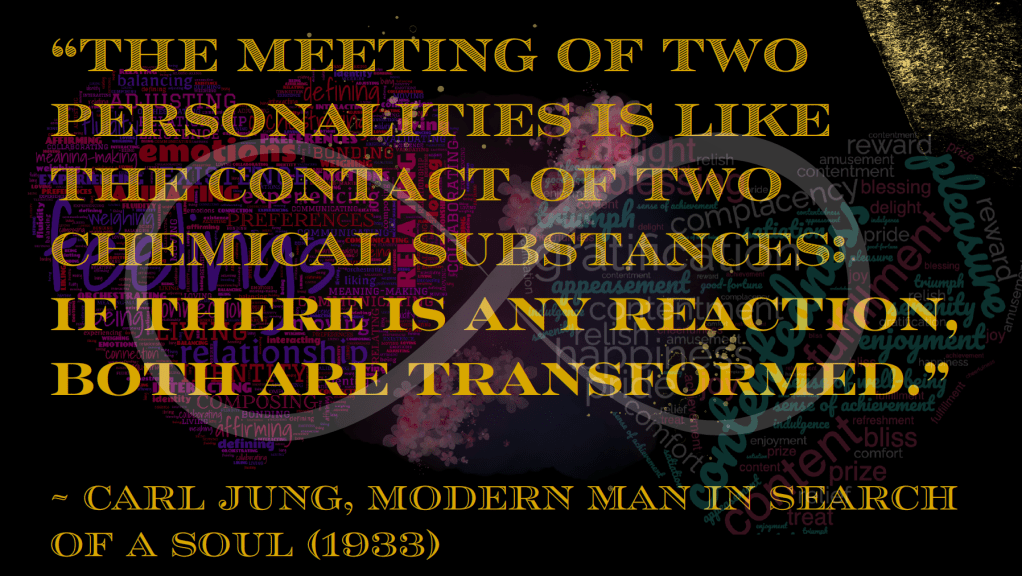
on a transpersonal level and when done responsibly, attuning ignites the alchemical process of healing through relationship. perhaps, the art of attunement is the art of relationship.
References
American Counseling Association. (2014). Code of ethics and standards of practice. https://www.counseling.org/resources/aca-code-of-ethics.pdf
Bretherton, I. (1992). The origins of attachment theory: John Bowlby and Mary Ainsworth. Developmental Psychology, 28(5), 759—775. https://doi-org.turing.library.northwestern.edu/10.1037/0012-1649.28.5.759
Carlquist, E., Nafstad, H. E., & Blakar, R. M. (2018). Understanding satisfaction: An analysis of the potential of the word “satisfaction” in everyday Norwegian language. Journal of Happiness Studies: An Interdisciplinary Forum on Subjective Well- Being, 19(4), 939–959. http://dx.doi.org.turing.library.northwestern.edu/10.1007/s10902-017-9854-1
Cartwright, C., Barber, C., Cowie, S., & Thompson, N. (2018). A trans-theoretical training designed to promote understanding and management of countertransference for trainee therapists. Psychotherapy Research, 28(4), 517—531. https://doi-org.turing.library.northwestern.edu/10.1080/10503307.2016.1252017
Cavelzani, A., & Tronick, E. (2016). Dyadically expanded states of consciousness and therapeutic change in the interaction between analyst and adult patient. Psychoanalytic Dialogues, 26(5), 599–615. https://doi-org.turing.library.northwestern.edu/10.1080/10481885.2016.1214478
Coan, J. A., Beckes, L., Gonzalez, M. Z., Maresh, E. L., Brown, C. L., & Hasselmo, K. (2017). Relationship status and perceived support in the social regulation of neural responses to threat. Social Cognitive & Affective Neuroscience, 12(10, 1574—1583. https://doi-org.turing.library.northwestern.edu/10.1093/scan/nsx091
Coan, J. A., Kasle, S., Jackson, A., Schaefer, H. S., & Davidson, R. J. (2013). Mutuality and the social regulation of neural threat responding. Attachment & Human Development, 15(3), 303—315. https://doi-org.turing.library.northwestern.edu/10.1080/14616734.2013.782656
Coyne, A. E., Constantino, M. J., Gains, A. N., Laws, H. B., Westra, H. A., & Antony, M. M. (2021). Association between therapist attunement to patient outcome expectation and worry reduction in two therapies for generalized anxiety disorder. Journal of Counseling Psychology, 68(2), 182—193. https://dx.doi.org/10.1037/cou0000457
Egozi, S., Tishby, O., & Wiseman, H. (2021). Therapeutic distance in client-therapist narratives: Client attachment, therapist attachment, and dyadic effects. Psychotherapy Research, 31(8), 963—976. https://doi-org.turing.library.northwestern.edu/10.1080/10503307.2021.1874069
Elliott, R., & Greenberg, L. S. (2007). The essence of process-experiential/emotion-focused therapy. American Journal of Psychotherapy, 61(3), 241—254.
Erskine, R. G. (1998). Attunement and involvement: Therapeutic responses to relational needs. International Journal of Psychotherapy, 3(3), 234—244.
Finn, C., Johnson, M. D., & Neyer, F. J. (2020). Happily (n)ever after? Codevelopment of romantic partners in continuing and dissolving unions. Developmental Psychology, 56(5), 1022–1028. http://dx.doi.org.turing.library.northwestern.edu/10.1037/dev0000897
Fraley, R. C., Waller, N. G., & Brennan, K. A. (2000). Experiences in Close Relationships Questionnaire—Revised [Database record]. PsycTESTS. https://doi.org/10.1037/t03763-000
Goldblatt, M. J., & Ronningstam, E. F. (2023). Self-silencing and suicide. Practice Innovations. https://doi-org.turing.library.northwestern.edu/10.1037/pri0000215
Goldman, R., Greenberg, L., & Pos, A. (2005). Depth of emotional experience and outcome. Psychotherapy Research, 15(3), 248—260. https://doi-org.turing.library.northwestern.edu/10.1080/10503300512331385188
Gonzalez, O. F., Perez, J. C., & Krause, M. (2019). The relation between the therapeutic alliance and communicative intentions in therapeutic interaction during the initial phase of adolescent therapy. Research in Psychotherapy: Psychopathology, Process and Outcome, 22(2), 189—198. https://doi.org/10.4081/ripppo.2019.356
Graham, J. M., Diebels, K. J., & Barnow, Z. B. (2011). The reliability of relationship satisfaction: A reliability generalization meta-analysis. Journal of Family Psychology, 25(1), 39–48.
Greenberg, L. (2014). The therapeutic relationship in emotion-focused therapy. Psychotherapy, 51(3), 350—357. https://doi-org.turing.library.northwestern.edu/10.1037/a0037336
Havas, E., Svartberg, M., & Ulvenes, P. (2015). Attuning to the unspoken: The relationship between therapist nonverbal attunement and attachment security in adult psychotherapy. Psychoanalytic Psychology, 32(2), 235—254. http://dx.doi.org/10.1037/a0038517
Hayes, J. A., Gelso, C. J., Goldberg, S., & Kivlighan, D. M. (2018). Countertransference management and effective psychotherapy: Meta-analytic findings. Psychotherapy, 55(4), 496—507. https://doi-org.turing.library.northwestern.edu/10.1037/pst0000189
Joel, S., Eastwick, P. W., Allison, C. J., Arriaga, X. B., Baker, Z. G., Bar-Kalifa, E., Bergeron, S., Birnbaum, G. E., Brock, R. L., Brumbaugh, C. C., Carmichael, C. L., Chen, S., Clarke, J., Cobb, R. J., Coolsen, M. K., Davis, J., de Jong, D. C., Debrot, A., DeHass, E. C., … & Wolf, S. (2020). Machine learning uncovers the most robust self-report predictors of relationship quality across 43 longitudinal couples studies. Psychological and Cognitive Sciences, 117(32), 19061–19071. http://dx.doi.org.turing.library.northwestern.edu/10.1073/pnas.1917036117
Johnson, S. M. (2013). Love sense: The revolutionary new science of romantic relationships. First edition. New York, Little, Brown and Company.
Johnson, S. M. (2019). Attachment theory in practice: Emotionally focused therapy (EFT) with individuals, couples, and families. The Guilford Press.
Johnson, S. M., & Campbell, T. L. (2022). A primer for emotionally focused individual therapy (EFIT): Cultivating fitness and growth in every client. Routledge. DOI: 10.4324/9781003090748-6
Johnson, S. M., & Greenman, P. S. (2006). The path to a secure bond: Emotionally focused couple therapy. Journal of Clinical Psychology, 62(5), 597—609. https://doi-org.turing.library.northwestern.edu/10.1002/jclp.20251
Khayyat-Abuaita, U., Paivio, S., Pascual-Leone, A., & Harrington, S. (2019). Emotional processing of trauma narratives is a predictor of outcome in emotion-focused therapy for complex trauma. Psychotherapy, 56(4), 526—536. https://doi-org.turing.library.northwestern.edu/10.1037/pst0000238
Klein, M. H., Mathieu, P. L., Gendlin, E. T., & Kiesler, D. J. (1969). The experiencing scale: A research and training manual (Vol. 1). Madison: Wisconsin Psychiatric Institute.
Kossak, M. (2008). Attunement and free jazz. Voices: A World Forum for Music Therapy, 8(2). https://doi.org/10.15845/voices.v8i2.431
Kramer, U., & Timulak, L. (2022). The emotional underpinnings of personality pathology: Implications for psychotherapy. Clinical Psychology: Science and Practice, 29(3), 275—286. https://doi-org.turing.library.northwestern.edu/10.1037/cps0000080
Landrum, B., & Davis, M. (2023). Experiencing oneself in the other’s eyes: A phenomenologically inspired reflexive thematic analysis of embodiment for female athletes. Qualitative Psychology, 10(2), 245—261. https://doi-org.turing.library.northwestern.edu/10.1037/qup0000256
Levine, A., & Heller, R. S. F. (2010). Attached. The new science of adult attachment and how it can help you find – and keep – love. TarcherPerigree.
Levy, K. N., & Spina, D. S. (2022). The centrality of a representation-based framework for understanding the emotional underpinnings of personality pathology: A commentary on “The emotional underpinnings of personality pathology: Implications for psychotherapy.” Clinical Psychology: Science and Practice, 29(3), 287—290. https://doi-org.turing.library.northwestern.edu/10.1037/cps0000103
Lewis, T. H., Amini, F., & Lannon, R. (2001). A general theory of love. Vintage Books: New York.
Li, W., Woudstra, M. J., Branger, M. C. E., Wang, L., Alink, L. R. A., Mesman, J., & Emmen, R. A. G. (2019). The effect of the still-face paradigm on infant behavior: A cross-cultural comparison between mothers and fathers. Infancy, 24(6), 893—910. https://doi-org.turing.library.northwestern.edu/10.1111/infa.12313
Morelli, S. A., Torre, J. B., & Eisenberger, N. I. (2014). The neural bases of feeling understood and not understood. Social Cognitive & Affective Neuroscience, 9(12), 1890—1896. https://doi-org.turing.library.northwestern.edu/10.1093/scan/nst191
Ratts, M. J., Singh, A. A., Nassar-McMillan, S., Butler, S. K., McCullough, J. R. (2016). Multicultural and social justice counseling competencies: Guidelines for the counseling profession. Journal of Multicultural Counseling and Development, 44(1), 28—48. https://doi-org.turing.library.northwestern.edu/10.1002/jmcd.12035
Rocco, D., Gennaro, A., Salvatore, S., Stoyecheva, V., & Bucci, W. (2017). Clinical mutual attunement and the development of therapeutic process: A preliminary study. Journal of Constructivist Psychology, 30(4), 371—387. https://doi-org.turing.library.northwestern.edu/10.1080/10720537.2016.1227950
Schreiber, A. M., Wright, A. G. C., Beeney, J. E., Stepp, S. D., Scott, L. N., Pilkonis, P. A., & Hallquist, M. N. (2020). Disrupted physiological coregulation during a conflict predicts short-term discord and long-term relationship dysfunction in couples with personality pathology. Journal of Abnormal Psychology, 129(5), 433—444. https://doi-org.turing.library.northwestern.edu/10.1037/abn0000526.supp
Sharf, R. S. (2016). Theories of psychotherapy and counseling: Concepts and cases (6th ed). Boston: Cengage.
Snyder, J., & Silberschatz, G. (2009). Patient’s Experience of Attunement and Responsiveness—Patient Version [Database record]. Retrieved from PsycTESTS. doi: https://dx.doi.org/10.1037/t64398-000
Snyder, J., & Silberschatz, G. (2017). Patient’s Experience of Attunement and Responsiveness Scale—Therapist Version [Database record]. Retrieved from PsycTESTS. doi: https://dx.doi.org/1037/t64400-000
Snyder, J., & Silberschatz, G. (2017). The Patient’s Experience of Attunement and Responsiveness Scale. Psychotherapy Research, 27(5), 608—619. https://doi-org.turing.library.northwestern.edu/10.1080/10503307.2016.1147658
Soma, C. S., Baucom, B. R. W., Xiao, B., Butner, J. E., Hilpert, P., Narayanan, S., Atkins, D. C., & Imel, Z. E. (2020). Coregulation of therapist and client emotion during psychotherapy. Psychotherapy Research, 30(5), 591—603. https://doi-org.turing.library.northwestern.edu/10.1080/10503307.2019.1661541
Stiegler, J. R., Molde, H., & Schanche, E. (2018). Does an emotion-focused two-chair dialogue add to the therapeutic effect of the empathic attunement to affect? Clinical Psychology & Psychotherapy, 25(1), e86—e95. https://doi-org.turing.library.northwestern.edu/10.1002/cpp.2144
Swift, J. K., & Parkin, S. R. (2017). The client as the expert in psychotherapy: What clinicians and researchers can learn about treatment processes and outcomes from psychotherapy clients. Journal of Clinical Psychology, 73(11), 1486—1499. https://doi-org.turing.library.northwestern.edu/10.1002/jclp.22528
Talia, A., Muzi, L., Lingiardi, V., & Taubner, S. (2020). How to be a secure base: Therapists’ attachment representations and their link to attunement in psychotherapy. Attachment & Human Development, 22(2), 189—206. https://doi-org.turing.library.northwestern.edu/10.1080/14616724.2018.1534247
Tishby, O., & Wiseman, H. (2022). Countertransference types and their relation to rupture and repair in the alliance. Psychotherapy Research, 32(1), 29—44. https://doi-org.turing.library.northwestern.edu/10.1080/10503307.2020.1862934
Tronick, E. Z. (2007). The neurobehavioral and social-emotional development of infants and children. New York, NY: Norton.
Watson, J. C. (2018). Empathy and responsiveness in emotion-focused therapy. In O. Tishby & H. Wiseman (Eds.), Developing the therapeutic relationship: Integrating case studies, research, and practice. (pp. 235—255). American Psychological Association. https://doi-org.turing.library.northwestern.edu/10.1037/0000093-011
Watson, J. C. (2018). Mapping patterns of change in emotion-focused psychotherapy: Implications for theory, research, practice, and training. Psychotherapy Research, 28(3), 389—405. https://doi-org.turing.library.northwestern.edu/10.1080/10503307.2018.1435920
Watson, J. C., & Bedard, D. L. (2006). Clients’ emotional processing in psychotherapy: A comparison between cognitive-behavioral and process-experiential therapies. Journal of Consulting and Clinical Psychology, 74(1), 152—159. https://doi-org.turing.library.northwestern.edu/10.1037/0022-006X.74.1.152
Watson, J. C., Gordon, L. B., Stermac, L., Kalogerakos, F., & Steckley, P. (2003). Comparing the effectiveness of process-experiential with cognitive-behavioral psychotherapy in the treatment of depression. Journal of Consulting and Clinical Psychology, 71(4), 773-781. https://doi-org.turing.library.northwestern.edu/10.1037/0022-006X.71.4.773
Winterheld, H. A. (2016). Calibrating use of emotion regulation strategies to the relationship context: An attachment perspective. Journal of Personality, 84(3), 369—380. https://doi-org.turing.library.northwestern.edu/10.1111/jopy.12165
[i] Graham et al., 2011; Finn et al., 2020; Carlquist et al., 2018
[ii] Joel et al., 2020
[iii] (Johnson & Greenman, 2006)
[iv] (Landrum & Davis, 2023)
[v] (Lewis et al., 2001)
[vi] (Cavelzani & Tronick, 2016; Jones et al., 2020)
[vii] (Johnson, 2013)
[viii] (Johnson, 2013, p. 67).
[ix] (Coan et al., 2013)
[x] (Schreiber et al., 2020; Soma et al., 2020)
[xi] (Morelli et al., 2014)
[xii] O. Hobart Mowrer [Johnson, S. (2013). Love sense: The revolutionary new science of romantic relationships. Little, Brown Spark. p. 61]
[xiii] Sue Johnson [Johnson, S. (2013). Love sense: The revolutionary new science of romantic relationships. Little, Brown Spark. p. 62]
[xiv] Eugene T. Gendlin (1986, p. 178)
[xv] (Winterheld, 2016)
[xvi] (Bretherton, 1992)
[xvii] (Cavelzani & Tronick, 2016; Tronick, 2007)
[xviii] (Kossak, 2008, para. 8)
[xix] C.G. Jung, The Archetypes and the Collective Unconscious
[xx] (Snyder & Silberschatz, 2017)
[xxi] (Johnson & Greenman, 2006)
[xxii] (Greenberg, 2014)
[xxiii] (Egozi et al., 2021)
[xxiv] (Coan et al., 2017)
[xxv] (Goldblatt & Ronningstam, 2023)
[xxvi] (Coyne et al., 2021; Rocco et al., 2017; Stiegler et al., 2018)
[xxvii] (Watson, 2018)
[xxviii] (Erskine, 1998, p. 237)
[xxix] (Erskine, 1998)
[xxx] (Johnson & Campbell, 2022, p. 107)
[xxxi] (Egozi et al., 2021)
[xxxii] (Talia et al., 2020)
[xxxiii] (Egozi et al., 2021)
[xxxiv] (Johnson, 2019; Levine & Heller, 2010; Levy & Spina, 2022)
[xxxv] (Talia et al., 2020).
[xxxvi] (Li et al., 2019)
[xxxvii] (Li et al., 2019)
[xxxviii] (Swift & Parkin, 2017)
[xxxix] (ACA, 2014)
[xl] (Ratts et al., 2016)
[xli] (Snyder & Silberschatz, 2009; Snyder & Silberschatz, 2017)
[xlii] (Sharf, 2016)
[xliii] (Morelli et al., 2014)
[xliv] (Morelli et al., 2014)
[xlv] (Morelli et al., 2014)
[xlvi] (Johnson, 2013)
[xlvii] (Talia et al., 2020)
[xlviii] (Talia et al., 2020)
[xlix] (Talia et al., 2020)
[l] (Talia et al., 2020)
[li] (Cartwright et al, 2018; Hayes et al., 2018)
[lii] (Tishby & Wiseman, 2022)
[liii] (Khayyat-Abuaita et al., 2019)
[liv] (Kramer & Timulak, 2022)
[lv] (Gonzalez et al., 2019)
[lvi] (Havas et al., 2015)
[lvii] (Elliott & Greenberg, 2007)
[lviii] (Klein et al., 1969)
[lix] (Watson, 2018)
[lx] (Watson & Bedard, 2006)
[lxi] (Watson, 2018; Watson et al., 2003)
[lxii] (Goldberg et al., 2005)
[lxiii] (Greenberg, 2014)
 e.vol.ve.re studio
Leave a comment