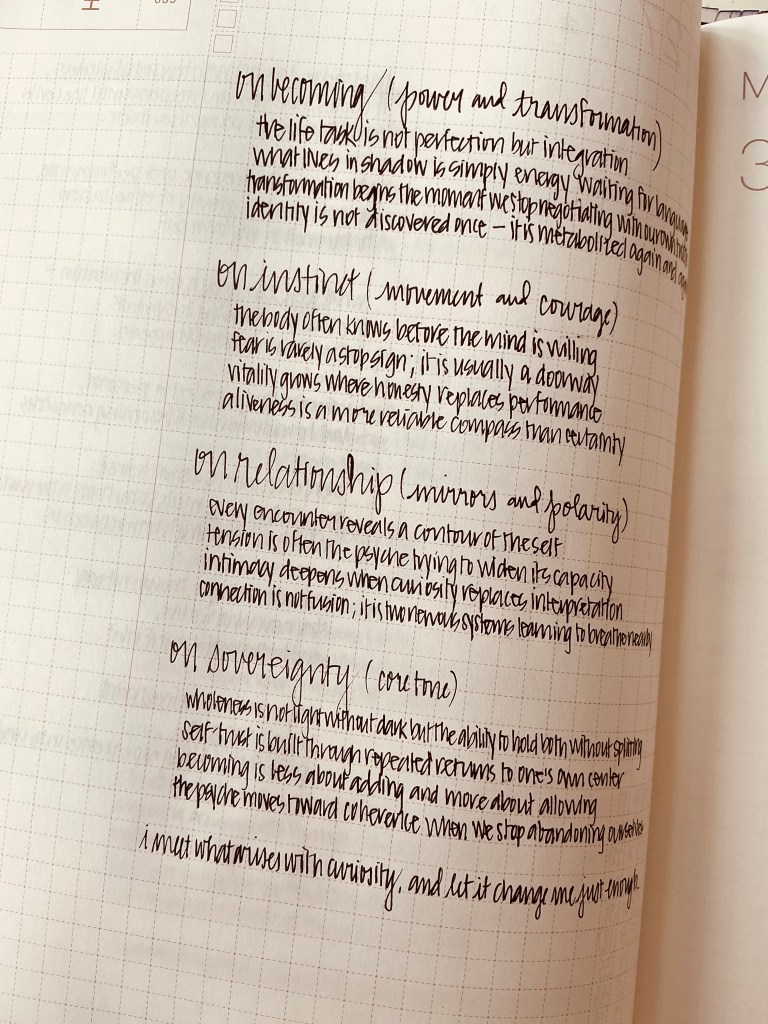
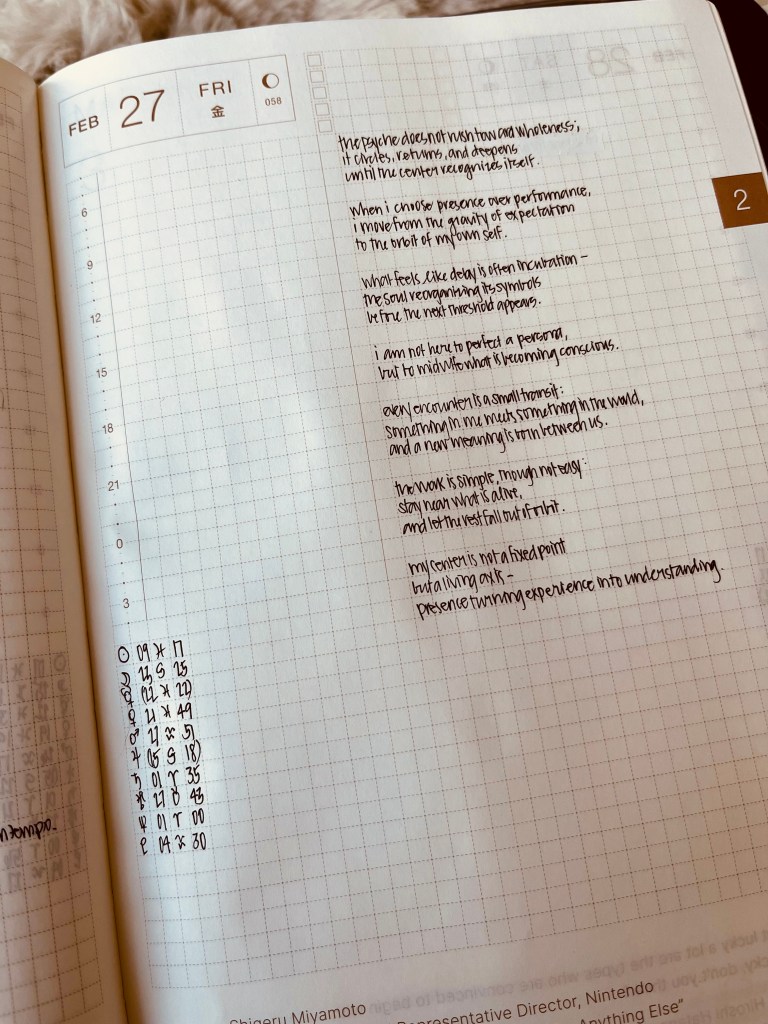
presently absorbed with the evolutionary process, whether it involves finding inspiration, a return to ourselves, sitting in wonder and awe, quietly sipping on some tea — essentially, our relationship to everything — all-the-while trusting the process.

#unfold #develop #expand

small observations, fragments, and ideas in motion 
a place for passing thoughts and borrowed language

  • the architecture of performance

    there is a particular kind of exhaustion that develops when a person spends too long organizing themselves around adaptation rather than authenticity.

    not dramatic collapse.
    not obvious falseness.

    just the quiet fatigue of constantly asking:
    “how do i do this correctly?”
    instead of:
    “what is true for me?”

    many people move through life learning how to become legible before they learn how to become whole.

    the nervous system studies environments carefully:
    what earns approval?
    what prevents rejection?
    what keeps connection intact?
    what version of me survives best here?

    eventually, a self begins to organize around performance.

    sometimes the performance looks like achievement.
    sometimes competence.
    sometimes usefulness.
    sometimes emotional control.
    sometimes hyper-independence.
    sometimes endless agreeability.
    sometimes becoming whatever the room unconsciously rewards.

    and because these adaptations often work externally, they are rarely questioned immediately.

    they become identity.

    but beneath many symptoms is not simply pathology.
    often there is a divided self.

    the adapted self.
    the protected self.
    the socially rewarded self.

    and somewhere underneath:
    the self that never fully stopped waiting for permission to exist naturally.

    this week, two clinical conversations unexpectedly circled the same center.

    one client began recognizing the difference between externalized power and intrapersonal power.

    externalized power often depends upon:
    dominance.
    control.
    positioning.
    being “above.”
    being untouchable.

    it requires constant maintenance because it is stabilized externally.

    the field must remain organized around the self in order for the self to feel coherent.

    but intrapersonal power feels different.

    it is quieter.
    less performative.
    less dependent upon comparison.

    it does not require the diminishment of others in order to exist.

    alfred adler wrote extensively about compensation and superiority striving, observing that domination often emerges not from wholeness, but from attempts to protect against inferiority and inadequacy.

    karen horney later described similar movements psychologically:
    the self expanding defensively outward through control, perfection, certainty, or power in order to avoid helplessness and anxiety internally.

    rollo may differentiated authentic power from violence and domination, arguing that control often intensifies precisely when the self feels inwardly unstable.

    erich fromm wrote that domination can become an escape from vulnerability and freedom itself.
    not true strength,
    but protection against aliveness.

    and jung repeatedly circled the danger of becoming possessed by persona:
    the socially adaptive self eventually mistaken for the whole self.

    perhaps this is part of why domination becomes evolutionarily futile over time.

    it may secure temporary positioning.
    temporary compliance.
    temporary authority.
    temporary protection from shame.

    but domination cannot create mutuality.
    it cannot generate authentic intimacy.
    it cannot produce integrated selfhood.

    it only keeps the nervous system locked in external regulation:
    control the environment.
    control the perception.
    control the uncertainty.
    control the exposure.

    meanwhile the authentic self remains underdeveloped beneath the performance structure.

    in this sense, domination is often not power at all.
    it is dependency disguised as strength.

    dependency upon:
    admiration.
    authority.
    control.
    compliance.
    centrality.
    external stabilization.

    another client spoke about imposter syndrome and the anxiety of “doing life correctly.” underneath the self-monitoring was a deeper question:
    “am i becoming myself the right way?”

    perhaps one of the most radical psychological shifts is realizing that individuation is not a standardized process.

    there is no universally correct way to become oneself.

    there is only the slow, often uncomfortable process of becoming less divided against oneself.

    perhaps healing is not becoming better at performing a self,
    but becoming less fragmented from the self already there.

    this process changes relationships, too.

    because once a person becomes sensitive to congruence, they begin feeling the difference between:
    presence and role.
    authenticity and performance.
    care and control.
    love and management.
    selfhood and adaptation.

    they can feel when someone disappears into persona.
    they can feel when survival eclipses self.
    they can feel when emotional connection becomes filtered through defensiveness, usefulness, authority, or fear.

    and often, the deeper longing beneath relationship is not simply:
    “does this person love me?”

    but:
    “can this person remain emotionally congruent while being loved?”

    because being deeply seen can feel dangerous to defended structures.

    if love threatens the persona,
    many people retreat back into performance.

    back into competence.
    back into control.
    back into certainty.
    back into usefulness.

    the role survives.
    the self disappears again.

    perhaps that is part of individuation too.

    not abandoning connection,
    but learning to recognize the difference between relationships built through performance and relationships capable of tolerating authenticity.

    because under every persona is a nervous system that once learned survival before wholeness.

    and beneath many defenses is not evil,
    but fear.

    fear of exposure.
    fear of inadequacy.
    fear that if the performance stops, nothing worthy will remain.

    but the innate continues pressing upward anyway.

    quietly.
    persistently.

    wanting expression.
    wanting integration.
    wanting a life no longer organized entirely around adaptation.

    perhaps the work is not teaching people who to become.

    perhaps the work is helping remove what obscures who they already are.

  • on emotional déjà vu

    there is a particular kind of melancholy that does not come from physical solitude.

    it comes from feeling psychologically finalized inside the minds of other people.

    the moment someone begins relating more to their internal version of you than to your living reality, something subtle begins collapsing inside the relationship.

    curiosity softens. attention narrows. presence becomes replaced by familiarity.

    not always maliciously. often very quietly.

    at first, many relationships are organized around discovery.

    tell me everything. what shaped you? what frightens you? what do you keep hidden? how do you experience the world? why are you the way you are?

    there is openness then. a kind of psychological spaciousness. the feeling of being encountered rather than interpreted.

    eventually the relationship begins generating a kind of emotional déjà vu.

    conversations no longer feel fully encountered in the present. they begin arriving already partially anticipated.

    over time, many people unconsciously begin stabilizing one another into emotional shorthand.

    i know how you are. i know what this means. i know how this conversation ends.

    and while some degree of pattern recognition is natural inside intimacy, there is a threshold where familiarity quietly hardens into assumption.

    the person is no longer being discovered.

    they are being referenced.

    this can create a profound loneliness for people whose inner worlds continue evolving long after others have emotionally archived them into a fixed identity.

    especially for psychologically perceptive people, intimacy often depends less on agreement and more on continued curiosity.

    not: understand me once.

    but: remain open to who i may still be becoming.

    some of the deepest grief inside long-term relationships emerges when one person begins feeling emotionally pre-written inside the other person’s mind.

    every reaction becomes anticipated. every emotion partially categorized before it fully arrives. every conversation begins colliding against assumptions already waiting in the room.

    and over time, the person begins exhausting themselves trying to correct the image.

    this creates a strange form of relational fatigue.

    the more carefully someone tries to explain themselves accurately, the less natural they begin feeling.

    language becomes labor.

    instead of: this is what i feel,

    the internal process quietly shifts toward: how do i say this in a way that will not immediately become something else inside their interpretation of me?

    that is not emotional presence.

    it is translation exhaustion.

    there is another sorrow underneath this too.

    many people are most curious during the projection stage of intimacy.

    when attraction is new, attention flows easily. mystery creates fascination. possibility keeps perception awake.

    but familiarity can sometimes create the illusion that another person has already been fully known.

    people stop looking closely. stop asking. stop listening beneath expectation.

    they begin relating to the role instead of the living person. the narrative instead of the nervous system. the remembered version instead of the evolving interior world sitting quietly in front of them.

    perhaps real intimacy requires something much rarer than initial fascination.

    the ability to remain curious after certainty becomes available.

    to allow another person to continue surprising you. to resist emotionally completing them. to understand that selfhood is not static enough to be fully summarized by memory, role, or prior experience.

    perhaps this is why some forms of loneliness become more acute inside relationships than outside them.

    because being unseen by strangers carries one kind of sadness.

    being unseen by someone who believes they already know you carries another entirely.

  • the depth beneath the harmony

    there are relationships where the problem is not lack of love.

    the problem is that love and protection become woven together so tightly that two people begin hearing the relationship through different emotional frequencies without fully realizing it.

    one person listens for subtle changes in atmosphere the way others listen for changes in pitch.

    a pause held slightly too long.
    a shift in enthusiasm.
    a sentence that lands half a tone flatter than usual.
    a warmth that disappears almost imperceptibly before returning again.

    they move toward closeness through language.
    through reflection.
    through emotional precision.
    trying to name the song accurately enough that both people might finally stop losing rhythm with one another.

    the other person moves toward regulation differently.

    through movement.
    music.
    work.
    humor.
    small practical rituals that lower emotional intensity enough for the nervous system to remain inside the relationship without becoming emotionally flooded by it.

    they may love deeply while still feeling overwhelmed by prolonged emotional scrutiny or the pressure of being unable to repair what they sense drifting out of tune between them.

    both people leave the interaction feeling alone in different ways.

    one feels:
    i keep trying to hear you clearly, but something keeps fading underneath the words.

    the other feels:
    i keep failing at a song i do not fully understand how to play.

    this is where many relationships become trapped inside the false binary of emotion versus logic.

    but often neither person is actually emotionally absent.

    they are simply regulating through different rhythms.

    some nervous systems move toward emotional intensity searching for resonance.
    others instinctively soften, narrow, or lower the emotional volume in order to preserve internal equilibrium.

    one person keeps trying to bring the relationship into sharper emotional focus.
    the other keeps trying to keep the atmosphere gentle enough to remain inside it.

    meanwhile, love quietly exhausts itself trying to bridge the distance between two adaptive tempos.

    this is why emotional resonance matters more than agreement.

    agreement is cognitive.
    resonance is relational.

    resonance says:
    i can feel that this matters to you.
    i can feel your loneliness beneath the words.
    i know we are missing each other right now.
    i may not fully understand your music yet, but i am still listening for it.

    without resonance, relationships often begin shifting from connection into interpretation.

    every pause becomes amplified.
    every silence acquires emotional texture.
    small fluctuations in warmth, pacing, or responsiveness begin carrying disproportionate meaning.

    people stop resting inside the relationship and begin listening for dissonance instead.

    and strangely, the relationship may still contain genuine harmony.

    that is what makes these dynamics so psychologically difficult.

    the person who feels emotionally under-met may still witness moments of softness:
    a hand resting quietly on the shoulder after conflict.
    a question revisited hours later in a gentler tone.
    music playing softly in the same room after tension has settled but not fully disappeared.
    a private self surfacing briefly before retreating again beneath composure.

    the relationship is not empty enough to leave easily.
    not settled enough to fully exhale inside.

    so both people continue oscillating between closeness and protection, hoping the other might eventually recognize the emotional language their nervous system has been playing all along.

    sometimes the deepest longing in a relationship is not:
    love me more.

    it is:
    please do not make me perform my humanity alone just to remain audible to you.

  • rituals of continuity

    there are forms of exhaustion that do not want insight.

    only warm food.
    low lighting.
    familiar flavors.
    silence that does not require immediate excavation.

    sometimes after emotional overwhelm, the nervous system reaches first for sensory continuity rather than interpretation.

    a meal.
    a familiar drink.
    a body settling slowly into the couch after hours of internal pressure.
    takeout containers opened quietly between people who are still carrying unresolved atmosphere.

    not every difficult moment becomes metabolized immediately through conversation.

    sometimes the psyche is not ready yet.

    sometimes emotional reality still exists too close to the surface.
    still partially unorganized.
    still moving through the body faster than language can comfortably hold.

    and during those moments, ordinary rituals can begin functioning almost like temporary emotional scaffolding.

    shared food.
    familiar pacing.
    warmth.
    ordinary continuity.

    small forms of care that do not resolve the rupture, but soften the nervous system enough to remain near it.

    sometimes people eat together while tension still quietly sits at the table beside them.

    not because the conflict no longer matters,
    and not because avoidance suddenly becomes healing,

    but because the body occasionally asks for regulation before deeper repair becomes possible.

    there is something profoundly human about this.

    two people still feeling misunderstood in slightly different ways.
    still emotionally saturated.
    still uncertain how to bridge the distance completely.

    yet briefly united inside something sensory and ordinary.

    basil.
    spice.
    warm rice noodles.
    shared silence.
    the soft sound of containers opening in low light.

    perhaps this is part of why food becomes emotionally symbolic so often across human life.

    not only because it nourishes,
    but because it creates atmosphere.

    because certain meals become associated with relief.
    with pause.
    with continuity after disruption.
    with being accompanied quietly through difficult emotional weather.

    sometimes repair begins not through immediate resolution,
    but through smaller moments that allow the nervous system to stop bracing quite so intensely.

    a warm container passed across the room.
    fried rice noodles eaten slowly in shared silence.
    the temporary softening that occurs when the body remembers it still belongs to the living world.

  • defenses as intelligent adaptation 

    defense mechanisms are often discussed as though they are evidence of weakness, avoidance, or lack of self-awareness.

    but many defenses begin as remarkably intelligent adaptations.

    a child who minimizes emotion may have learned that vulnerability overwhelmed the people around them.

    someone who intellectualizes may have discovered that analysis created distance from emotional chaos.

    humor may have softened humiliation.
    hyper-independence may have reduced disappointment.
    perfectionism may have created predictability inside instability.
    numbing may have allowed survival during experiences too large to metabolize fully at the time.

    the nervous system does not develop defenses arbitrarily.

    it develops them in relationship to what once felt necessary for emotional survival, belonging, coherence, or safety.

    the difficulty is that strategies which protect us in one environment can quietly constrain us in another.

    what once prevented overwhelm may later prevent intimacy.
    what once maintained safety may later limit flexibility.
    what once preserved identity may later interrupt connection to self, emotion, or others.

    and because many defenses become integrated early, they often stop feeling like strategies altogether.

    they begin to feel like personality.
    logic.
    humor.
    competence.
    detachment.
    control.
    self-sufficiency.

    perhaps healing is not the sudden destruction of defenses.

    perhaps it is the gradual ability to recognize when protection is no longer required in quite the same way.

    to understand that the nervous system was attempting to help,
    even when the strategy eventually became costly.

  • attachment & coherence

    people often imagine emotional maturity as the absence of sensitivity.

    but perhaps maturity has less to do with becoming unaffected,
    and more to do with developing enough internal stability to encounter differing realities without immediate collapse of self.

    because when identity becomes too fragile, nearly everything begins to feel personal.

    a differing opinion becomes rejection.
    a question becomes criticism.
    a clarification becomes humiliation.
    a boundary becomes abandonment.
    another perspective becomes threat.

    not necessarily because the person is irrational,
    but because the nervous system has fused coherence of self with safety.

    and so meaning becomes tightly managed.

    interpretations harden.
    certainty becomes protective.
    ambiguity feels intolerable.

    this is part of why attachment and identity are often deeply intertwined.

    humans do not only seek connection with others.
    we also seek continuity within ourselves.

    perhaps emotional flexibility requires the gradual realization that being influenced by another person’s reality does not automatically erase our own.

    that we can remain permeable without disappearing.

    that meaning can expand without identity collapsing alongside it.

  • adaptation mistaken for identity

    some adaptations become so practiced that they are eventually mistaken for personality.

    the person described as “easygoing” may have simply learned very early that taking up less space preserved connection.

    the highly competent person may have once lived in environments where mistakes carried emotional consequences.

    the one praised for calmness may actually be monitoring every variable in the room before reacting.

    the deeply independent person may have learned not to expect reliable support.

    the person who is “good with people” may be continuously tracking tone, pacing, expression, and emotional shifts in order to maintain relational safety.

    over time, survival strategies often become integrated so thoroughly that neither the individual nor the people around them recognize them as adaptations anymore.

    they begin to look like identity.

    maturity.
    strength.
    professionalism.
    self-sufficiency.
    pleasantness.
    perceptiveness.
    resilience.

    and sometimes these qualities are real.

    but sometimes they are also what remains after the nervous system spends years shaping itself around what felt necessary for belonging, stability, predictability, or emotional survival.

    perhaps part of self-awareness involves gently asking:

    what in me is essence,
    and what in me was learned in response to the environments i had to navigate?

  • environmental sensitivity

    people do not move through environments in the same way.

    some experience space primarily through function.
    others through atmosphere.

    some notice whether a task was completed.
    others notice pace, texture, sound, lighting, rhythm, interruption, placement, emotional tone.

    neither orientation is inherently wrong.
    but differences in environmental sensitivity can quietly shape relational experience in powerful ways.

    especially because nervous systems often become intertwined with the spaces they inhabit repeatedly.

    for some people, order creates calm.
    for others, flexibility creates ease.
    some feel regulated through structure.
    others through spontaneity.

    and often these differences are discussed practically rather than emotionally, which can obscure what is actually being experienced beneath the surface.

    because sometimes what appears to be frustration with “small things” is actually a nervous system trying to communicate:
    this environment feels difficult for me to settle inside.

    perhaps attunement is not only emotional.

    perhaps it also includes learning the landscapes in which another person can most fully exhale.

  • family systems & incompatible realities

    sometimes family tension does not emerge from lack of love, but from incompatible relationships to reality itself.

    one person remembers through emotion.
    another through sequence.
    one through symbolism.
    another through detail.
    one is trying to preserve meaning.
    another is trying to preserve accuracy.

    and beneath the conversation, something quieter is often happening:

    each person is trying to protect coherence of self.

    because memory is rarely just memory.

    it is identity.
    history.
    positioning.
    survival.
    continuity.

    this is part of why small clarifications inside families can become emotionally charged so quickly.

    the discussion is no longer only about what happened.

    it becomes entangled with:
    who is allowed to define reality,
    whose perception is trusted,
    whose experience carries weight,
    and whether love can survive differing versions of the same moment.

    sometimes people are not actually arguing over facts.

    they are trying to remain intact while standing beside another person’s truth.

  • emotional openness & permeability

    one of the quieter forms of relational attunement is the ability to remain emotionally open while being shown something we may not have seen before.

    not perfection.
    not total agreement.
    not never misunderstanding.

    just the capacity to stay connected long enough to consider:
    “this person may be offering me information, not diminishing me.”

    many relational ruptures begin in moments so small they are almost invisible.

    a detail clarified.
    a memory remembered differently.
    a preference refined.
    a meaning adjusted.

    often the content itself is not the true rupture.

    the deeper question underneath the interaction is something closer to:
    what happens inside me when certainty softens?

    for some people, these moments feel collaborative.
    two perspectives meeting.
    reality becoming more textured through contact.

    for others, being corrected can carry the emotional atmosphere of exposure, instability, loss of footing, embarrassment, or disconnection.
    the nervous system reacts before reflection has time to arrive.

    and so the conversation quietly shifts from curiosity toward self-protection.

    not necessarily out of arrogance,
    but often out of learned vulnerability.

    many people grew up in environments where mistakes carried emotional consequences.
    where being wrong meant ridicule, withdrawal, shame, or loss of belonging.

    over time, the self learns to protect coherence very quickly.

    but intimacy asks something difficult of us.

    it asks whether another person’s experience can influence our own without immediately feeling like injury.

    whether we can remain permeable to each other’s reality while still remaining whole within ourselves.

    perhaps this is part of why seemingly small moments can carry such disproportionate emotional weight in relationships.

    beneath the interaction, the nervous system is often asking:
    is there room for me to exist here accurately?

    attunement requires humility.

    not humiliation.
    humility.

    the willingness to let another person add to the map without experiencing the revision as annihilation.

  • invisible adaptation / relational climates

    there are forms of adaptation that become nearly invisible because they function so well.

    the person who anticipates tension before it arrives.
    the one who softens the room.
    the one who notices shifts in tone, timing, atmosphere, facial expression, pacing.
    the one who translates complexity into something easier for others to hold.

    over time, these adaptations are often mistaken for personality.

    competence.
    maturity.
    “being good with people.”
    professionalism.
    calmness.

    but many highly attuned people are carrying entire relational climates in real time.

    not because they are weak.
    not because they are irrational.

    because somewhere along the way, awareness became linked to safety.

    and eventually the body learns:
    notice first.
    adjust quickly.
    reduce friction.
    maintain connection.

    sometimes so automatically that the person themselves no longer realizes how much effort is being expended beneath the surface.

    the tragedy is not simply exhaustion.

    it is how often invisible adaptation becomes the very thing others begin to expect.

  • when the mirror clouds,
    the self keeps moving.

    e.vol.ve.re studio

  • from the margins

  • curiosity is often the moment healing begins to enjoy itself.

    e.vol.ve.re studio

  • the privilege of a lifetime is to become who you truly are.

    carl jung

  • in every story, there is a hero and a villain. 
    in your story, you are both.

    adrian iliopoulos

  • perfection is achieved, not when there is nothing more to add, but when there is nothing left to take away.

    antoine de saint-exupery

  • where love rules, there is no will to power; and where power predominates, there love is lacking. the one is the shadow of the other.

    carl jung

  • the greatest good you can do for another is not just share your riches, but to reveal to him his own.

    benjamin disraeli

  • everything that irritates us about others can lead us to an understanding of ourselves. your visions will become clear only when you can look into your own heart. who looks outside, dreams; who looks inside, awakes. until you make the unconscious conscious, it will direct your life and you will call it fate.

    carl jung

  • no tree, it is said, can grow to heaven unless its roots reach down to hell.

    carl jung
  • without integration, we will destroy everything we love and become the things we fear.

    self

  • incredible podcast show. especially poignant are the episodes with andrey – a highly intelligent business owner. not a fan of some of the titles, but please disregard them and approach them with curiosity.

    how should we treat others?

    there are no others.

    ramana maharshi
  • i’ve never seen any life transformation that didn’t begin with the person in question finally getting tired of their own bullshit.

    elizabeth gilbert
  • sex is just a coded language for our deepest emotional needs, because tell me how you were loved, and i will know a lot how you make love.

    esther perel

    on the importance of intimacy (and what it really means) in relationship.


    on healing from sexual abuse –

    when you are able to reclaim control. but the control is not about saying “no.” the control is actually about saying “yes.” there is no greater freedom than voluntarily giving yourselves over. that’s the thing that is robbed from us when we are coerced… [the choice to say “yes] is to giving myself to you, to being with you, to trusting you, to giving myself the permission to enjoy.

    there is no greater vengeance for anyone who has experienced abuse than to reclaim control, connection, and pleasure…

    esther perel

    on modern monogamy –

    it really says – what it threatens – “we are replaceable. we are not indispensable and we are not unique. and in our culture of individualism, it’s a slap in the face… yes, there was before and there could be even after. and we live with that.”

    esther perel

    on conflict in relationship –

    conflict is part of love and relationships. all relationships. but don’t think that what matters is what you’re fighting about, but always ask yourself “what is it that i am fighting for?

    what people fight for when they fight is usually three things. you fight for care and closeness, you fight for respect and recognition, and you fight for power and control. who makes the decisions? whose priorities matter more? power and control. care and closeness – do you have my back? can i trust you? and respect and recognition – can you value me?

    esther perel
  • are enough of your needs being met to grieve the ones that aren’t?

    terry real

    now, if there is no safety in relationship to discuss needs, that’s a different story. getting curious (as opposed to getting defensive or judgmental) about another’s experience of you cultivates a foundation of safety and security to feel connection and intimacy. courage requires asking the other “i’m curious… what is your experience of me?”, and it takes equal courage to share.

    we’re constantly co-creating or destroying in relationship.

    i do like to think, too, that the best partners do kind of challenge each other to become better versions of themselves…


    [on challenging each other]

    “hey, if you notice something i’m doing that’s not good for me or not good for the relationship, i would love for you to speak up about it because you’re going to help me become a better version of me.”

    rikki cloos
  • in defense of bottom-up understanding and improvisational interventions, and the interpersonal corrective emotional experience via unconscious right brain coregulation (as opposed to auto-regulation, self-help, or simply cognitive or behavioral intervention)

  • Comment
    byu/lilacmacchiato from discussion
    intherapists
  • an over-six-hour video about trauma and a psychosomatic storm via a jungian lens

  • excellent video on overall theoretical orientation/worldview, and the power of antipathologizing

  • “permission to feel”. thank you, marc brackett, for unlocking the key to up-leveling the human experience.

  • we live in a house of mirrors and think we are looking outside the windows.

    fritz perls

  • every human has a true authentic self. trauma is the disconnection from it and healing is the reconnection to it.

    dr. gabor mate

  • we do not make our fantasies, they make us.

    ((james hillman))
  • the meeting of two personalities is like the contact of two chemical substances: if there is any reaction, both are transformed.

    ((carl jung, modern man in search of a soul (1933)))
  • perhaps love is the process of my gently leading you back to yourself.

    ((antoine de saint-exupery))
  • the art of attunement

    our relationships are everything.

    (more…)
  • super crispy.

    it’s part of the process.

light listening

just a little texture, if you want it